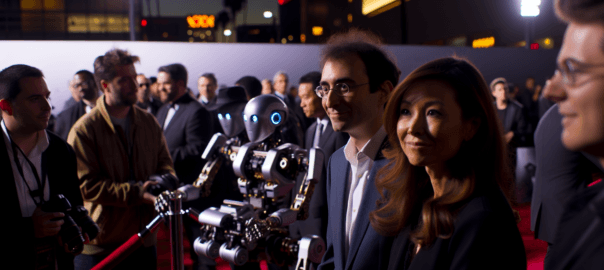
The AI Film Festival in Silicon Valley proved AI is moving from tool to creative partner in feature filmmaking.
The inaugural AI Film Festival in Silicon Valley reframed how we think about machine creativity. Short films are no longer the only playground. Feature-length work premiered. Policy leaders and industry heavyweights showed up. The festival collected over 2,000 AI-generated submissions and fused film with fashion and robotics. For context on how AI is reshaping screens and living rooms, see this preview of AI in TV from TechCrunch: Google previews new Gemini features for TV at CES. The scene is changing fast.
As someone who swaps between composing piano pieces and prototyping telecom tech, I found the festival oddly familiar. I once taught a neural net to harmonize a melody and it politely ignored my tempo instructions — the AI had its own taste. Running startups taught me to accept creative surprises. Seeing AI-directed feature work felt like watching a student orchestra suddenly improvise a symphony. It was both unnerving and exhilarating — and yes, I still prefer coffee-fueled late-night edits to algorithmic perfection.
AI Film Festival
The Silicon Valley AI Film Festival, held January 10–11, 2026, showcased a rapid evolution in AI-driven cinema. The event, title-sponsored by Pollo AI, drew more than 2,000 AI-generated film submissions worldwide, spanning narrative, animation, experimental work and feature-length projects. Organizers framed the festival as a space where AI becomes a creative partner rather than a mere tool. The festival’s scope and scale—and the world premiere of Wolf Pack by 冰河 Bing He—signal a maturing ecosystem for AI filmmaking.
From shorts to features
For years AI’s visible output in film was limited to experimental shorts. At this festival those boundaries shifted. Wolf Pack is being described as the world’s first feature-length AI film independently completed by a single creator. Festival co-founder 蔣鹤婷 Cynthia (Heting) Jiang called it a new production model. These milestones show how AI can assist in visual generation, style transfer, and even narrative construction—moving the medium into more systematized, industry-scale expression.
Numbers, awards and notable voices
Organizers received 2,000+ submissions, a number that highlights both interest and capacity in the field. The Grand Prix went to White Night Lake by Shangguan Wenqing. The Jury Grand Award was given to AI Revelation: Destruction by Zhong Yun, and Wen Ye won Best Director for The Fantasy of a “Tree”. Keynote speakers included director Lu Chuan and representatives such as California State Treasurer Fiona Ma. The festival’s press release and program details are available via the original coverage at the Columbia Daily Tribune event report.
Cross-disciplinary experiments
Beyond screenings, the festival fused film, fashion and robotics. Silicon Valley Fashion Week collaborated with Unitree Robotics to place intelligent robots in fashion showcases—an experiment in real-world AI aesthetics. Executive Deputy Director 鲁睿 Vanessa Rui Lu stressed the festival’s role as an exchange platform. Regina Binyang Nie emphasized the first-time fusion of film, fashion, and technology, expanding how creators conceive visual expression.
Ethics, policy and the road ahead
Panels tackled copyright, ethics, and education. Attendees included policy figures like Gary Yu and cultural delegates. Speakers such as Elena Shao from NVIDIA and producer Michael Whalen debated commercial viability and rights management. With government commendations presented by representatives for California and Massachusetts, the festival is already part cultural forum, part policy laboratory—pushing AI filmmaking toward open, responsible practice. The AI Film Festival is now less a novelty and more a proving ground for the next wave of cinematic storytelling.
AI Film Festival Business Idea
Product: Launch a cloud-native production platform called FrameForge AI: an end-to-end studio for AI-assisted feature film production. FrameForge AI combines generative image/video models, narrative scaffolding tools, automated continuity checks, and a collaboration hub for directors, VFX teams, and rights managers. It supports ingest of actor footage, style transfer pipelines, and editable story blueprints.
Target market: Independent filmmakers, small studios, film schools, VFX boutiques, and fashion-technology collectives exploring cross-disciplinary shows. Initial customers: creators who submitted to festivals like the Silicon Valley AI Film Festival and studios experimenting with AI-enhanced features.
Revenue model: subscription tiers (creator, studio, enterprise), per-project compute credits, marketplace commissions for model/asset sales, and an enterprise licensing option for major studios. Provide pro support and certified workflows for IP compliance.
Why now: The festival proved demand—2,000+ submissions and a feature-length world premiere show a fast-growing market. With policy interest and cross-disciplinary collaborations emerging, FrameForge AI captures creators shifting to AI-as-partner production methods, when tooling and policy signals align.
Where Creativity Meets Code
The Silicon Valley AI Film Festival shows a future where algorithms and artists co-write stories at scale. This is not replacement; it is augmentation. When responsibly governed, AI can broaden who tells stories and how. The festival’s 2,000+ submissions and a feature-length premiere are proof points. What would you create if AI were a trusted co-author in your next film?
FAQ
Q1: What was the scale of submissions to the Silicon Valley AI Film Festival?
A1: The festival received over 2,000 AI-generated film submissions, including shorts, animations, experimental pieces, and feature-length entries.
Q2: Which feature-length AI film premiered at the festival?
A2: The world premiere of Wolf Pack, directed by 冰河 Bing He, was presented and described as a feature-length AI film independently completed by a single creator.
Q3: Who were notable attendees and partners at the event?
A3: Attendees included director Lu Chuan, California State Treasurer Fiona Ma, NVIDIA senior director Elena Shao, and partners like Pollo AI and Unitree Robotics; Silicon Valley Fashion Week was integrated into the program.