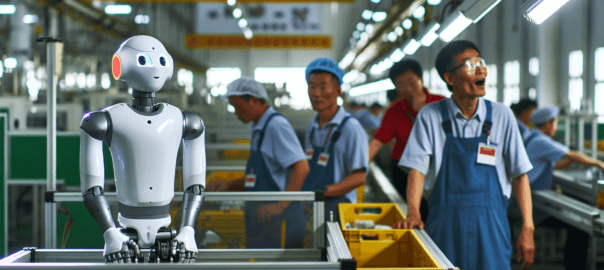
Humanoid robot coworker is arriving from China with surprising speed, quirks, and serious workplace implications.
Humanoid robot coworker platforms are accelerating faster than many expected. Short bursts of capability. Longer lists of questions. Chinese companies are leading the charge with compact, agile designs that already perform walking, lifting, and semi-autonomous tasks. The scene matters for technologists and policy makers alike. I’ve written about AI security and governance before; readers may find context in Why VCs Are Betting Big on AI Security Against Rogue Agents and Shadow AI. Expect practical deployments, workplace friction, and sharp innovation battles this year.
At a robotics demo in Shenzhen I once watched a compact humanoid stumble theatrically before nailing a precision lift. It reminded me of late-night lab tests at Ericsson—where a prototype network can be both brilliant and oddly awkward. I love that mix: academic rigor, entrepreneurial haste, and a relentless push to iterate. As someone who’s wired networks, built startups, and occasionally plays piano for patience, I think the real story is how quickly these machines will join human teams—and the funny, awkward moments that follow.
humanoid robot coworker
The wired report describes a 4-foot-tall humanoid that behaves ‘a bit drunk’, leaping and then abruptly walking with an outstretched arm. That vivid detail captures the gap between theatrical demos and reliable, repeatable work. Chinese firms are shipping compact, high-acceleration humanoids with limited dexterity but strong mobility. These devices already show explosive acceleration and interesting sensor setups—some engineers talk about ‘eyes in the back of its head’ for 360-degree awareness. The source story comes from WIRED and is available here, highlighting both the capability and the risks.
What the machines can do, today
Mobility is the immediate strength. A 4-foot platform can walk, balance, and perform pick-and-place tasks in a controlled environment. Speed often outpaces finesse. Grippers and tactile dexterity lag. That means these humanoid robot coworker designs excel at tasks requiring locomotion and basic object handling, not delicate assembly or creative problem solving. Expect factories, logistics hubs, and retail floors as primary early markets.
Workplace impacts and safety
Rapid acceleration and unpredictable gaits raise safety questions. Robots that lurch may misjudge human proximity. The WIRED piece emphasizes both spectacle and hazard: dramatic demos attract investors but reveal fragile control margins. Regulations and site-level safety protocols will matter. Companies must integrate collision detection, enforced speed limits, and clear human-robot zones. Until dexterity and predictability improve, these humanoid robot coworker systems will need robust human oversight.
Strategic implications
China’s industrial base, supply chains, and venture funding create a potent engine for humanoid robots. That manufacturing density shortens iteration cycles. For buyers, cost and delivery timing favor Chinese suppliers. For competitors and regulators, it raises geopolitical and standards questions. Will Western firms match the cadence or focus on specialized, higher-dexterity systems? The short answer: expect Chinese-made humanoid robots in many workplaces first, with implications for jobs, security, and industrial policy.
How to prepare
Organizations should map tasks by required dexterity and risk. Pilot low-risk deployments: inventory, pallet movement, basic customer service. Invest in integration tools, safety frameworks, and data governance. Treat these systems like fast-evolving platforms: monitor performance, collect metrics, and demand firmware and policy updates. The humanoid robot coworker is not a sci-fi stand-in. It’s a practical, messy, and near-term teammate that needs careful onboarding.
humanoid robot coworker Business Idea
Product: ‘CoPilot Safety & Integration’ — a software+hardware middleware that converts general-purpose Chinese humanoid robots into certified on-site coworkers. It bundles adaptive speed governors, standardized ROS-compatible drivers, task orchestration, and a safety compliance module with digital twin verification. Target market: logistics hubs, light manufacturing, retail distribution centers, and facilities managers in North America and Europe looking to import cost-competitive humanoids but lacking integration expertise. Revenue model: modular subscription (SaaS) for orchestration and analytics, per-robot commissioning fees, and certified hardware safety kits sold as CAPEX. Why now: Chinese suppliers are delivering hardware quickly, but customers struggle with safe, compliant integration. CoPilot monetizes the security and integration gap, reducing time-to-deploy from months to weeks and creating recurring revenue from analytics, firmware updates, and compliance audits. Pitch: we turn a promising but risky humanoid robot coworker into a predictable, insured asset for industrial operators, unlocking faster adoption while minimizing liability.
Tomorrow’s Team-Mates
Humanoid robot coworker platforms will enter workplaces sooner than many expect. They bring efficiency gains and operational headaches in equal measure. Success depends on integration, safety, and governance—not just striking demos. The companies that build the middleware, standards, and human-centered processes will capture the most value. What role would you want a robot to play on your team—logistics, inspection, or something more creative?
FAQ
Q: How soon will humanoid robot coworkers reach mainstream workplaces?
A: Expect pilot deployments in 2026–2027 in logistics and light manufacturing. Early units are compact (about 4 feet tall) with strong mobility but limited dexterity, so mainstream uptake will be phased.
Q: Are Chinese humanoid robots safer or riskier?
A: Chinese firms lead on iteration speed and supply chain scale, which lowers cost and shortens delivery. But higher acceleration and immature dexterity can increase safety risk without strict integration and guarding protocols.
Q: What should companies do before deploying a humanoid robot coworker?
A: Run a risk assessment, pilot low-risk tasks, install speed limits and collision detection, and require vendor firmware and safety certifications. Start with inventory or pallet tasks before moving to people-facing roles.