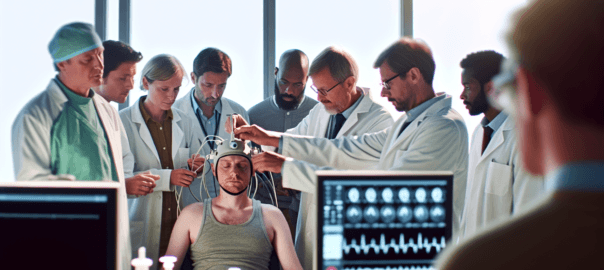
Merge Labs accelerates the brain-computer interface race with OpenAI’s backing, $252M, and ultrasound-based noninvasive tech.
Merge Labs emerged from stealth with $252 million and an audacious goal: read from and write to the brain without implants. The startup promises ultrasound-driven, molecule-based interfaces that avoid electrodes and surgical implants. OpenAI’s announcement highlights collaboration on scientific foundation models to interpret noisy neural data. This development ties directly into modern AI breakthroughs and enterprise-grade AI models that decode complex signals — a convergence of biology, devices, and machine learning that could reshape assistive tech and human augmentation.
As someone who writes scores and builds networks, I often joke that I try to compose for humans and machines at once. I once tuned a wireless audio rig and a neural net in the same week — one required patience and a metronome, the other, patience and a lot of data. That blend of music, engineering and entrepreneurship makes the Merge Labs news feel oddly familiar and deeply exciting to me.
Brain-Computer Interface
Merge Labs’ announcement marks a notable moment in neurotech. The company surfaced from stealth with $252 million in funding, led in part by OpenAI and Bain Capital. According to a report by WIRED, Merge plans to use ultrasound to both read neural activity and modulate the brain — but crucially, aims to avoid implants. Their website emphasizes connecting with neurons “using molecules instead of electrodes” and transmitting information with “deep-reaching modalities like ultrasound.”
What the funding means
$252 million buys time, talent, and hardware iteration. For a field where safety, regulatory clearance, and reproducibility slow progress, such capital accelerates clinical studies and hardware prototyping. Merge’s backers include OpenAI and industry figures; that mix signals both deep pockets and AI know-how. OpenAI said it will collaborate on “scientific foundation models and other frontier tools to accelerate progress,” highlighting that AI will be central to turning low-bandwidth, noisy signals into meaningful commands.
Noninvasive approach and technical trade-offs
The ultrasound, molecule-based approach positions Merge opposite companies using implantable electrodes. Avoiding implants lowers surgical risk and broadens accessibility. But noninvasive methods often trade signal fidelity for safety. That makes AI models — able to infer intent from noisy inputs — indispensable. As the company describes, “High-bandwidth interfaces will benefit from AI operating systems that can interpret intent, adapt to individuals, and operate reliably with limited and noisy signals.” In short, progress depends on hardware AND sophisticated machine learning.
Ethics, regulation, and competition
Competition is heating up: Neuralink, Synchron, and others are racing too. Merge’s pledge to avoid implants shifts the debate toward privacy, consent, and equitable access. Regulators will scrutinize claims and trial results. Investors will watch metrics: bit-rate of communication, false positive rates, safety endpoints, and user retention. For developers, the prize is new classes of assistive devices and augmented interfaces that could help people with paralysis or enable new productivity tools.
The phrase brain-computer interface now spans implantable chips and wearable ultrasound rigs. Merge Labs’ combination of deep capital, OpenAI partnerships, and a noninvasive pitch could reshape expectations about when and how people connect directly to machines.
Brain-Computer Interface Business Idea
Product: NeuralBridge — a noninvasive, ultrasound-based wearable platform that translates basic motor intent and attention states into API-driven inputs for apps and assistive tech. The headset uses Merge-style ultrasound sensing plus cloud-hosted foundation models to map neural patterns to control gestures and text commands.
Target market: Initially neurorehabilitation clinics and assistive-device users (stroke, ALS), then creative professionals and AR/VR users seeking hands-free control. Early adopters include hospitals, rehabilitation centers, and enterprise AR integrators.
Revenue model: Hardware-as-a-Service (HaaS) with a subscription for model updates and clinical analytics. Additional revenue from SDK licensing to app developers and per-seat enterprise deployments. Clinical trials and reimbursement pathways will unlock hospital procurement contracts.
Why now: $252M of recent investment and OpenAI collaboration lower technical and time-to-market barriers. Advances in foundation models for noisy signals mean reliable translation of intent is feasible. Noninvasive consumer demand and regulatory appetite for safer alternatives create a narrow window to capture market share before implants dominate mainstream narratives.
Toward a Responsible Neural Future
Merge Labs’ fusion of ultrasound hardware, molecule-based sensing, and AI models points to a future where brain-computer interfaces are safer and more accessible. The technology can empower people and create new human-machine workflows. But success will require transparent trials, robust privacy safeguards, and inclusive design. What would you build first if you could send a single command directly from thought to machine?
FAQ
Q: What is Merge Labs developing and how is it different?
A: Merge Labs is building noninvasive brain interfaces using ultrasound and molecule-based sensors. Unlike implantable approaches, it avoids electrodes in brain tissue and emphasizes AI-driven interpretation of noisy signals for broader accessibility.
Q: How much funding did Merge Labs raise and who invested?
A: Merge Labs launched with $252 million in funding. Key backers include OpenAI and Bain Capital, along with investors such as Gabe Newell, signaling both tech and strategic support.
Q: When could this technology reach patients or consumers?
A: Timelines vary; noninvasive prototypes could enter clinical trials within 1–3 years depending on safety data. Broad consumer adoption may take 3–7 years, tied to regulatory approvals and model validation.